On this page 5
When building autonomous software development platforms, giving an LLM tool access to bash execution is the ultimate double-edged sword. An unconstrained coding agent can accidentally overwrite system files, leak credentials, or become co-opted via prompt injection to pivot into internal networks.
In this technical breakdown, we examine the defense-in-depth architecture implemented in SuchTedium to safely execute untrusted, multi-turn AI coding workflows.
Interactive Architecture Overview
Explore our multi-tier isolation architecture in this interactive Archify diagram. Click on any node to inspect container constraints, hardware ceilings, and network boundaries:
1. Non-Root Execution and Defense-in-Depth
In default container configurations, processes often inherit root permissions inside the container namespace. If a kernel vulnerability is discovered, a root process can compromise the host node.
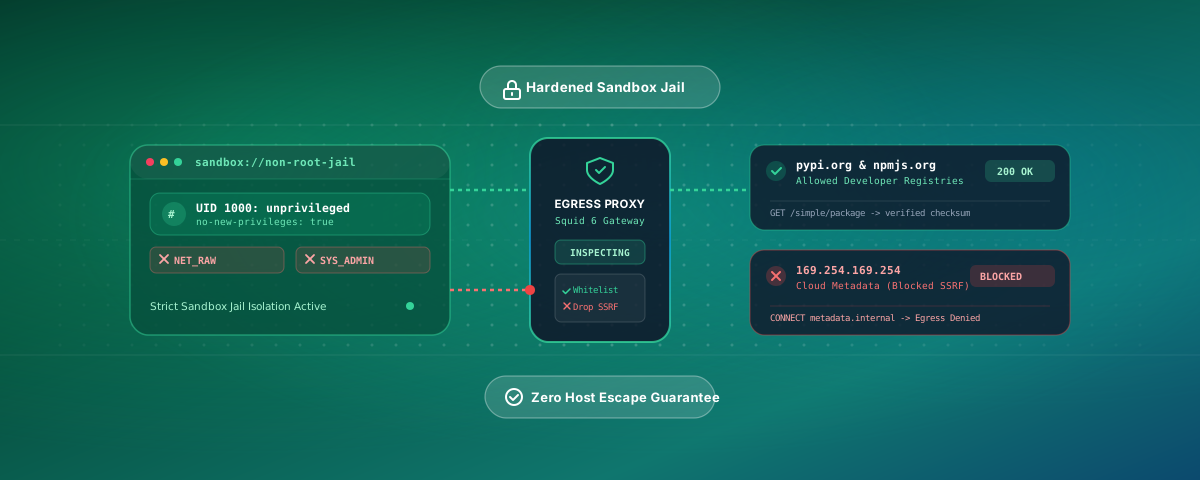
SuchTedium enforces strict non-root boundaries:
- Dedicated Unprivileged User: Agents execute inside sandboxes exclusively as a non-root user.
- No New Privileges: Hardened security options prevent privilege escalation through setuid binaries.
- Dropped Capabilities: The container runtime strips dangerous Linux capabilities, preventing raw socket manipulation, network routing modifications, or filesystem namespace alterations.
Each ephemeral session sandbox is constrained to dedicated CPU and memory ceilings, alongside strict command execution timeouts. Idle sessions automatically hibernate to return compute capacity to the cluster.
2. Egress Filtering and Network Controls
Direct, unrestricted access to the public internet creates Server-Side Request Forgery (SSRF) and data exfiltration risks during autonomous code execution. In SuchTedium, sandboxes run within an isolated network perimeter where outbound connectivity is strictly managed.
Security proxies help limit and govern outbound access from the sandbox:
- Allowlisted Registries: Outbound network requests are limited to trusted package repositories necessary for software development and builds.
- Private Network Protection: Access to cloud metadata endpoints and internal private networks is completely blocked, preventing lateral movement.
- Method & Protocol Inspection: Network proxies ensure that only expected protocols are used, preventing arbitrary data tunneling.
By routing outbound connections through specialized security proxies, the sandbox ensures the agent can install dependencies and build projects while keeping the broader network safe from unintended outbound calls.
3. Workspace Isolation & Safe Path Resolution
Every user session operates within a strictly partitioned, dedicated workspace:
- Isolated Session Roots: All file operations (creation, editing, compilation) are confined to the session’s mounted workspace folder.
- Safe Path Traversal Guard: Before any file is read, modified, or deleted by the agent core, canonical path resolution verifies that the target path does not escape the session perimeter. Any traversal attempt is immediately blocked.
- Audit Logging: Session actions and tool invocations are logged for enterprise governance and compliance readiness.
Session actions and tool invocations are tracked for audit readiness, ensuring transparent enterprise governance across all automated development sessions.
Experience Hardened AI Agents Today
See how container isolation unlocks true agent autonomy without compromising your enterprise security perimeter.