On this page 5
Multi-turn autonomous coding agents consume vast quantities of tokens. When an agent runs build scripts, inspects test failures, and refactors multiple source files, context windows quickly balloon beyond 60,000 tokens.
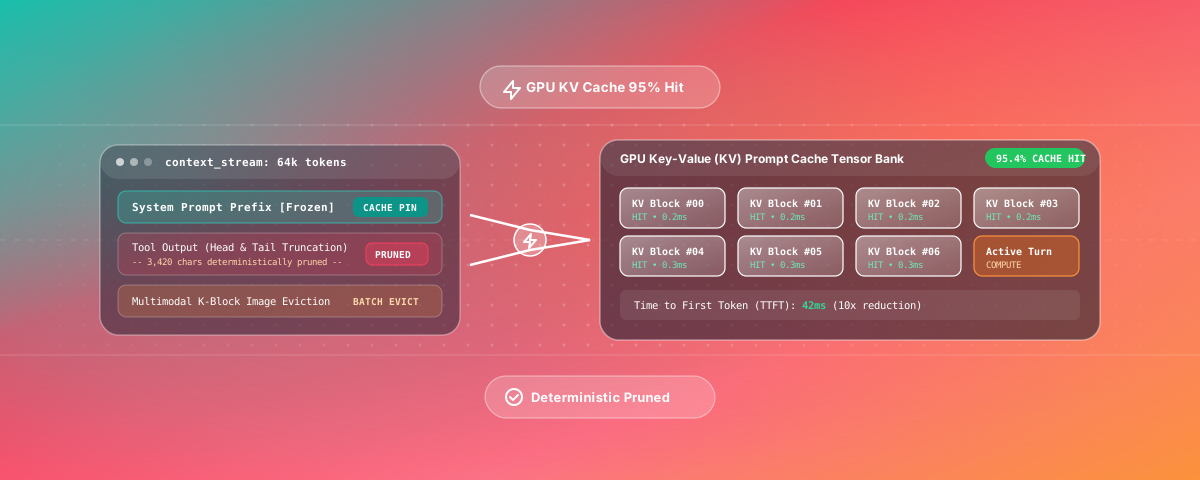
If an agent engine frequently truncates arbitrary messages or inserts variable metadata mid-prompt, it breaks server-side GPU KV (Key-Value) Prompt Cache alignment. When the prompt cache misses, latency spikes by 5x to 10x, and token compute costs skyrocket.
In this article, we explain the design of the context optimization and prompt caching engine inside SuchTedium.
Interactive Agent Execution Workflow
Step through the five phases of our context compaction and reasoning pipeline using this interactive Archify workflow diagram:
1. Deterministic Tool Pruning Before Summarization
Most agent frameworks resort to full LLM summarization calls whenever context limits approach. While effective, LLM summarization introduces significant latency and permanently alters the token prefix for all subsequent turns.
SuchTedium implements Deterministic Tool Pruning first:
- Length Ceiling: Any tool output exceeding length thresholds is deterministically pruned.
- Head / Tail Split: Preserves the command invocation and initial compiler headers alongside the final stack traces and summary lines.
- Marker Format: Inserts an explicit marker indicating truncated characters.
By performing this deterministically before touching the conversation history, the common prompt prefix remains byte-identical across consecutive iterations, maximizing server-side prompt cache reuse.
2. Multimodal Quantized Image Eviction
When users upload UI mockups, screenshots, or website wireframes, multimodal visual tokens occupy massive blocks of GPU tensor memory. If images are evicted one-by-one as new screenshots arrive, the visual token sequence constantly shifts.
To preserve cache warming, SuchTedium enforces Quantum Batch Eviction:
- Eviction Quantum: Images are evicted in fixed quantum blocks rather than individual drops.
- Trigger Threshold: Batch eviction triggers only when active image counts exceed predefined limits.
- Initial Context Protection: User wireframes or specification mockups submitted in early turns are anchored and protected from eviction.
By batching evictions into fixed quantums, the image tensor positions in the KV cache remain completely static across intermediate iterations, eliminating GPU recomputation.
3. Strict Tool Pairing Invariants
One common error in naive agent architectures is slicing context windows at arbitrary message indices. In modern tool-calling APIs, a message containing tool_calls must always be immediately followed by its matching tool result message.
If a sliding window cuts between a call and its result, the model provider rejects the prompt with an invalid structure error. SuchTedium’s compaction algorithms treat tool call/response pairs as indivisible atomic units.
Experience High-Performance Coding Agents Live
Experience sub-second reasoning responses, intelligent context pruning, and real-time deliverable generation on SuchTedium.