On this page 14
- Where enterprise tokens actually go: 2026 472-company benchmark
- Federated BU + IT ownership: why IT must never be the sole token owner
- Foundation Decision Models (“System One”): 35x faster and 200x cheaper by charging only for input tokens
- Intelligent model routing and October 2026 OpenRouter benchmarks
- October 2026 OpenRouter & Artificial Analysis Pareto model tiers
- Inference capacity tiers: goodput, PTU, and -50% Batch API
- Token minimization vs. token maximization
- Why output tokens cost 3x to 5x more than input tokens
- Prefix KV caching and auditing Token Yield Rate
- Scaling test-time compute and the saturation bound (N∗N^*N∗)
- AI FinOps governance, FOCUS 1.4 schemas, and CFO unit economics
- The four-level unit economics hierarchy and Business Unit goodput accountability
- 90-day execution roadmap
- References and primary sources
Enterprise AI spending grew 37x from $1.7 billion to over $64 billion in 2026 [6], with monthly corporate usage projected to reach 120 quadrillion tokens by 2030 [6]. Now that flat-rate seat licenses have shifted to usage-based token tiers [5], every AI call hits the corporate income statement (P&L) directly. Although 88% of companies use AI in 2026, only 23% generate measurable value at scale and just 6% report more than a 5% lift in EBIT [7].
Where enterprise tokens actually go: 2026 472-company benchmark
The September 2026 State of Tokenomics report across 472 enterprises with $4.6 trillion in combined revenue [1] shows that half of all companies run AI across four or more channels at once (direct APIs, cloud gateways, SaaS tools, and private servers). While 53% of companies can track their raw AI bill, 74% cannot prove business ROI to the CFO [1].
Frontier reliance drops from 51% to 24% in 12 months
50% of enterprises run 4+ channels simultaneously
Federated BU + IT ownership: why IT must never be the sole token owner
Reliance on closed frontier models drops from 51% of companies today to 24% over the next 12 months [1], and 20% already use open-weight models (Qwen3.8 Max, DeepSeek V4.1 Flash, GLM-5.3) in production. The key governance rule is simple: IT should never hold the token budget alone. When central IT pays the entire AI bill, business units do not bear the token cost and take no responsibility for goodput (usable token output that produces a business result) or failed retries [1], [7]. Companies where IT manages infrastructure efficiency while Business Units hold the cost_center budget and prove business outcomes are 3.7x more likely to prove ROI to the CFO, compared to 0% among the 12% of companies with no clear owner [1].
Foundation Decision Models (“System One”): 35x faster and 200x cheaper by charging only for input tokens
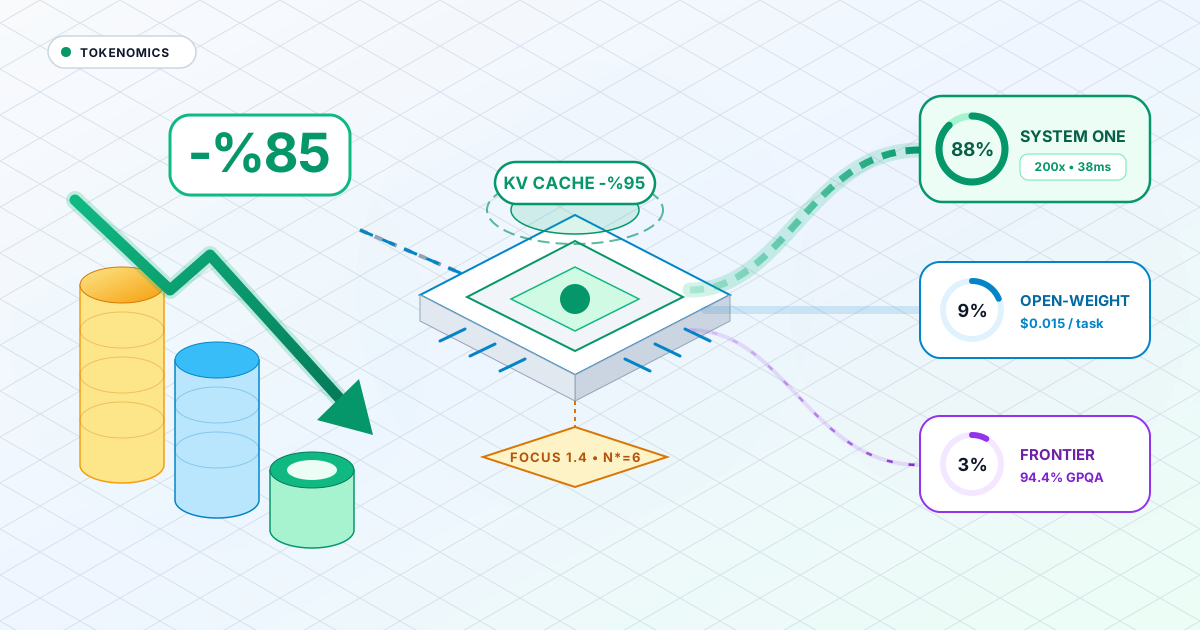
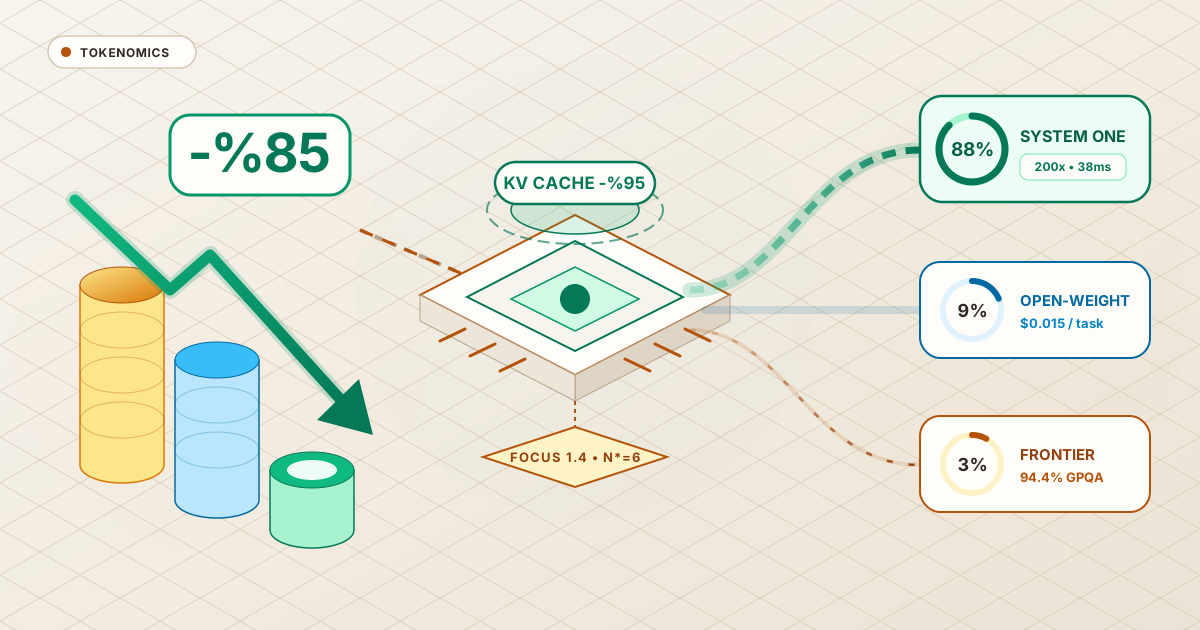
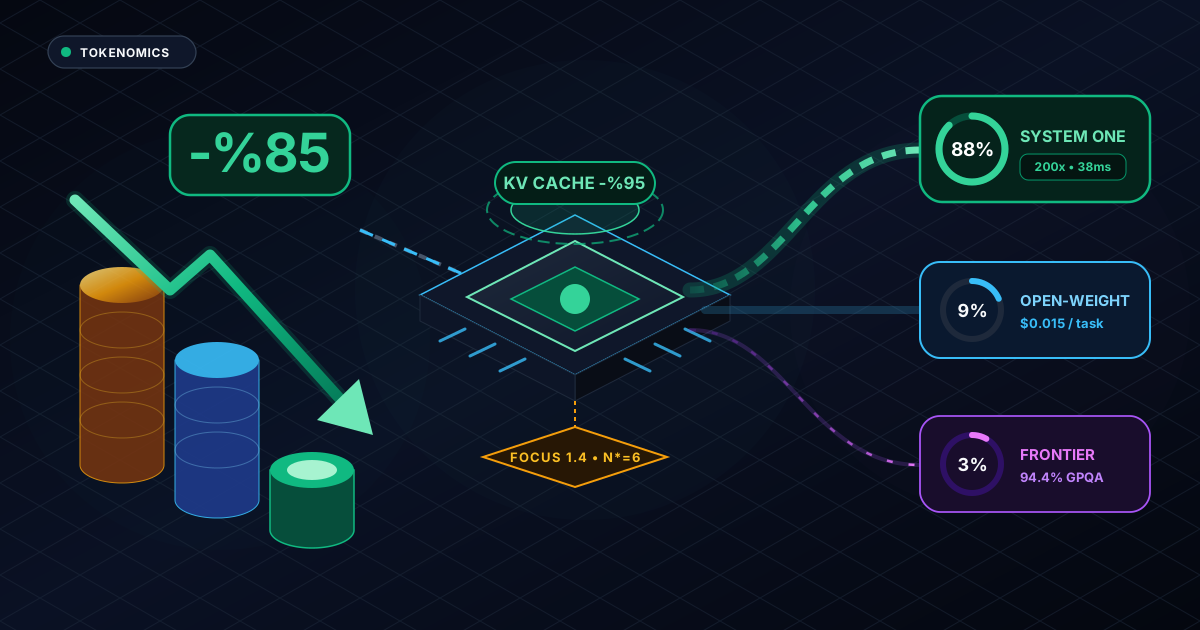
For years, companies used conversational LLMs for classification and approval decisions, waiting seconds just to generate {"status": "safe"} and paying 3x to 5x higher output token fees on top of input token costs [8], [13]. Introduced in Fall 2026 by TypeSafe AI (Jev), Microsoft (Decision-1), Cloudflare (Clef-flash), OpenAI, and AWS (Strands Decider), Foundation Decision Models (“System One”) do not generate text: they read context and candidate choices in a single pass and return probability scores directly [13]. These models charge for the input tokens they read, while avoiding output token fees because they emit no text [13]. Placing a decision model at the front door cuts total AI bills by over 90% by resolving 85% to 90% of routine requests at input-only token rates [13], powers sub-100ms search intent in Workday and Sana, and runs 40 to 150ms safety guardrails on autonomous agents before database or code actions execute [13].
88% Fast Lane (Input-Only)
12% Escalated
Intelligent model routing and October 2026 OpenRouter benchmarks
In 2026, 86% of enterprises use model routers, making them 4.0x more likely to prove ROI to the CFO [1]. Because 60% to 80% of company prompts do not need the largest frontier models [5], routers like RouteLLM and FrugalGPT cut token spend by 35% to 85% while keeping 95% of frontier quality [10].
October 2026 OpenRouter & Artificial Analysis Pareto model tiers
Data from the OpenRouter Benchmark API (/api/v1/benchmarks, October 15, 2026) [2] shows why teams must compare models across three charts at once: Cost per Task, Cost per 1M Input Tokens, and Cost per 1M Output Tokens. For instance, GPT-6.1 Sol has a high per-token price on long prompts, yet finishes tasks for $0.0214 at 94.4% GPQA Diamond accuracy [2] because it writes concise answers. Along the same efficiency curve sit Qwen3.8 27B ($0.015/task), DeepSeek V4.1 Flash ($0.0175/task), Claude Haiku 5.5 ($0.0195/task), Muse Spark 1.3 ($0.021/task), Claude Sonnet 5.5 ($0.0252/task), and Claude Opus 5.5 ($0.088/task) [2].
Recent routing evaluations (arXiv:2610.02762 [10]) show that connecting dozens of overlapping models to a router lowers decision quality because the router confuses prompt length with task difficulty. It treats short, hard math or coding prompts as easy and sends them to weak models, while treating long, simple email summaries as complex and sending them to expensive frontier models. To prevent this, limit your active catalog to three Pareto tiers: one fast compact model (DeepSeek V4.1 Flash, Claude Haiku 5.5, or Qwen3.8 27B), one open-weight generalist (Muse Spark 1.3 or Qwen3.8 Max), and one top frontier model (Claude Sonnet 5.5 or Claude Opus 5.5).
Inference capacity tiers: goodput, PTU, and -50% Batch API
Raw throughput counts every token a GPU server generates per second, even when heavy load makes responses too slow to use [4], [8]. Enterprises instead track goodput: usable responses that meet quality targets, start streaming on time (TTFT, Time to First Token), and maintain a readable speed (TPS, Tokens Per Second) [4]. On the hardware side, moving from NVIDIA Hopper H100 to Blackwell B200/GB200 servers lowers token generation cost by up to 25x while boosting throughput per megawatt 25x [4].
To prevent HTTP 429 rate-limit errors on live traffic (< 0.5s) without overbuying dedicated GPUs, teams reserve Provisioned Throughput Units (PTU / GSU) for baseline load and route sudden spikes to Priority / pay-as-you-go (PAYG) endpoints across Direct API, AWS Bedrock, and Vertex AI [3], [4]. Everyday chat and RAG queries run in the Goldilocks zone (1-2s latency with -90% KV cache discounts). Non-urgent jobs go to Flex Processing (5-60s) or the Async Batch API (< 24h), which cuts token prices by 50% in a separate quota pool that never slows down live users [3], [8].
Token minimization vs. token maximization
Every enterprise agent workflow consumes tokens across five parts [9]:
where is standard input tokens, is discounted cached input, is hidden reasoning tokens, is visible output, and is token traffic between multiple agents [9].
Why output tokens cost 3x to 5x more than input tokens
Model providers charge 3x to 5x more for output tokens than input tokens [2] ($2.00 input vs. $10.00 output on Claude Sonnet 5.5; $4.40 vs. $22.00 on Claude Opus 5.5). The reason is hardware execution: a GPU reads input text in parallel in a single pass, whereas generating output requires producing one word at a time and re-reading model weights from GPU memory for every token [4], [8].
Prefix KV caching and auditing Token Yield Rate
Keeping static system prompts and tool definitions in GPU KV cache memory cuts input read costs by 90% to 95% [2], dropping 1 million calls with a 6,600-token tool header from $13,200 down to $660. Teams also track Token Yield Rate to measure the share of tokens lost to retries, abandoned sessions, and failed quality checks [6], [9]:
Scaling test-time compute and the saturation bound ()
On hard tasks like software architecture or financial modeling, reasoning models (Claude Opus 5.5, Gemini 4 Argon, GPT-6.1 Sol) spend extra background thinking tokens () to improve accuracy. However, the accuracy gain from each extra thinking step drops rapidly toward zero following [9], [11]. Production systems should set a loop limit (circuit breaker) at the saturation step , where extra thinking steps no longer improve accuracy [9], [12]:
Halts recursive agent loops when marginal gain < ε
AI FinOps governance, FOCUS 1.4 schemas, and CFO unit economics
To combine fragmented cloud, API, and SaaS bills into one format, finance teams use the FinOps FOCUS 1.4 (June 2026) [3] standard, which separates input (x_InputTokens) and output (x_OutputTokens) costs:
Tagging every gateway call with trace_id, cost_center, and task_intent charges token spend directly to the owning Business Unit’s P&L instead of hiding it inside a central IT budget [1], [3].
The four-level unit economics hierarchy and Business Unit goodput accountability
While IT and Platform Engineering manage Levels 1 and 2 (lowering unit token rates and raising KV cache hit rates), Business Units (LoB VPs and Product Owners) hold the departmental token budget and must prove Level 3 goodput outcomes [1], [7]. For example, when a Compliance Business Unit replaces 80 analyst hours ($6,000 labor) with 2 hours of expert review ($150) plus $200 in goodput tokens ($350 total), that unit proves $5,650 in net P&L savings per cycle (94% cost reduction) to the CFO [7].
90-day execution roadmap
- Days 1 to 30 (Observability, FOCUS 1.4 & Federated BU Chargeback): Route all AI traffic through a central gateway tagging
trace_idandcost_center, collect bills in FOCUS 1.4 [3] format, and move token budgets from central IT to Business Unit + IT co-ownership where each BU proves its own goodput [1]. - Days 31 to 60 (Decision Models, 3-Tier Pareto Routing & KV Caching): Place a System One decision model (
TypeSafe Jev/Decision-1/Clef-flash) at the front door [13], restrict active LLMs to three Pareto tiers (DeepSeek V4.1 Flash/Claude Haiku 5.5,Muse Spark 1.3/Qwen3.8 Max, andClaude Sonnet 5.5/Opus 5.5) [2], [10], pin KV prefixes (-95%), and stop loops at [9]. - Days 61 to 90 (Business Unit Goodput Audits & Budget Reallocation): Require every Business Unit to report Level 3 metrics (Cost per Verified Outcome and Token Yield Rate) in monthly CFO reviews [6], shifting budget from low-goodput workflows to high-return teams [7].
References and primary sources
- Linux Foundation / FinOps Foundation: State of Tokenomics Report across 472 Enterprises (September 2026) · [Archive]
- OpenRouter Unified Benchmark API (
/api/v1/benchmarks: Artificial Analysis, GPQA Diamond & Tau-Bench, October 2026) · [Archive] - FinOps Foundation: Token Economics and the FOCUS 1.4 Specification (June 2026) · [Archive]
- NVIDIA AI: Enterprise Tokenomics Guide & Blackwell B200/GB200 Inference Economics · [Archive]
- Accenture: AI Tokenomics for Enterprise Value and C-Suite Governance · [Archive]
- Capgemini: The AI Compass Issue 1, AI Yield (October 2026) · [Archive]
- Deloitte: A CFO’s Guide to Governing the AI P&L · [Archive]
- arXiv:2606.24616: AI Tokenomics: The Economics of Tokens, Computation, and Pricing (June 2026) · [Archive]
- arXiv:2605.09104: Token Economics for LLM Agents: A Dual-View Study (May 2026) · [Archive]
- arXiv:2610.02762: Dynamic LLM Routers are Often Misguided (October 2026) · [Archive]
- arXiv:2604.10739: When More Thinking Hurts: Overthinking in LLM Test-Time Compute (April 2026) · [Archive]
- ICLR 2026: Zero-Overhead Introspection for Adaptive Test-Time Compute · [Archive]
- Foundation Decision Models (“System One”): TypeSafe AI Jev, Microsoft Decision-1, Cloudflare Clef-flash & AWS Strands Decider Benchmarks (Fall 2026) · [Archive]